POLYBOND™ PARA MERCADOS DE ALAMBRES Y CABLES HFFR

La dinámica del mercado está cambiando


Traditional PVC wire and cable insulation (sheathing) are declining in market demand. PVC is difficult to recycle, contains halogen, and passes off-gases of carcinogenic fumes when exposed to heat. New environmental regulations are beginning to focus on transitioning to halogen-free flame-retardant (HFFR) cable solutions. HFFR solutions require high loading rates (>60%), which can negatively impact the performance of the polymer system. The SI Group portfolio of POLYBOND™ coupling agents addresses those problems by improving the polymer's mechanical and physical properties. Wire and cable compounders using halogen-free flame-retardant solutions can benefit from adding POLYBOND™ into their formulations. 
 

THE NEW POLYBOND™ 3349

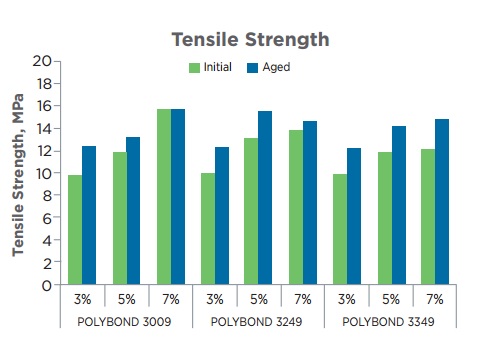
POLYBOND™ 3349 coupling agent allows for high load rates of HFFR without sacrificing the tensile strength, tensile modulus, and elongation properties of your compounds. Halogen-free flame-retardant wire and cable compounders will see outstanding flame-retardant dispersion and melt flow stability. High-demanding environments, such as automotive wire (EV and combustion engines), building and construction applications require.

How? POLYBOND™ 3349 aids by giving improved dispersion and adhesion of the halogen-free flame-retardant cable and wires (HFFR), helping regain the base polymer's physical properties and improve overall performance. 

 
All samples were prepared on a BUSS 30MX extruder at 12.5 kgs per hour with a melt temperature of 190°C. Aged samples were oven aged for 10 days at 100°C. Mechanical properties measured with 250 N load cell and separation speed of 250 mm per minute. EVA/LLDPE blend with 60% ATH.


SI Group's broad range of POLYBOND ™ coupling agents improves the mechanical performance of HFFR wire and cable compounds by strengthening the bond between the polyethylene polymer insulation and the filler. POLYBOND ™ polymer additives enhance physical properties, gel resistance, dispersion, and flame-retardant performance. 

  POLYBOND 3249      POLYBOND      POLYBOND POLYBOND 3149
MFI (g/10min) 8 8 5 3
Melting Temp. (C) 122 122 128 120
Elongation @ break (%) 576 443 48 70
Tensile Strength (Mpa) 13 11 22 14
Modulus (Mpa) 176 295 900 350
MAH% High High High Very High
Compatiblity
Tensile Strength      
Elongation    
Low Melt Processing Temp  
Gel Formation Resistance  

Resumen

Los agentes de acoplamiento POLYBOND™ muestran una resistencia significativa a la flexión y a la tracción al exponerse al envejecimiento térmico a largo plazo. Los fabricantes de compuestos para alambres y cables HFFR se beneficiarán de la mayor temperatura de deflexión térmica y la mejor dispersión del relleno. Haga clic a continuación para hablar con uno de nuestros expertos sobre qué grado de POLYBOND™ es el más adecuado para su formulación de alambres y cables.

Have Us Call You

Teléfono+52 55 6952 5030
Entregar